Collection

Recently added

Technical references added to the library in the last 90 days.

Sources
1044
Downloadable PDFs
270
Years
1984–2027

All sources

265–288 / 1044

Technical guidePDF

Open Compute Project Foundation 2025

Embodied Carbon Disclosure Base Specification v1 (OCP/iCA Carbon Disclosure Workstream), effective July 2025

Give catalogue items (UPS, generators, switchgear, cable, CDUs, racks, concrete) an embodied-carbon block: A1-A3 kg CO2e, functional unit, method (EPD/LCA/TM65/EEIO), verification status and emission factor source, matching this disclosure template.

  • The value is normalised to a functional unit; examples are 5.1 kg CO2e per metre of cable and 700 kg CO2e per 500 kW UPS.
Research paperPDF

Environmental Research: Energy (IOP Publishing) 2025

Empirically-Calibrated H100 Node Power Models for Reducing Uncertainty in AI Training Energy Estimation

Calculate AI training cluster energy and power demand from measured node power (here 7.3-7.79 kW in training, 76% of TDP) rather than TDP; a TDP-based estimate inflated a 20,000-GPU cluster by 19 GWh.

  • Even computationally intensive training workloads operated at only 76% of the 10.2 kW node TDP rating.
Research paperPDF

Sustainability (MDPI AG) 2023

Energy Consumption and Energy Saving Analysis of Air-Conditioning Systems of Data Centers in Typical Cities in China

Show evaporative free-cooling feasibility with a potential-hours study that bins the city's hourly wet-bulb distribution against mode thresholds (13 and 15 °C); in a humid climate direct evaporative mode ran only 262 h a year.

  • The air-system retrofit gave PUE below 1.39 everywhere; the best case was Xinjiang, 1.62 to 1.18 (69.26%).
Technical guidePDF

European Commission JRC 2024

Energy Consumption in Data Centres and Broadband Communication Networks in the EU (JRC135926, EUR 31841 EN)

In grid connection and permitting discussions account for regional concentration (data centres are 18% of national electricity in Ireland); in dense markets grid capacity and permitting can be a critical risk.

  • EU data centres used an estimated 45-65 TWh of electricity in 2022, 1.8-2.6% of total EU electricity use.
Research paperPDF

Scientific Reports (Springer Science and Business Media LLC) 2025

Energy efficiency enhancement in two European data centers through CFD modeling

Set up the retrofit workflow as KPI-guided: with a validated CFD model compute RCI, RHI, RTI and the recirculation index, then test rack repositioning, separators, sealing unused bays and removing badly placed ventilation units in sequence.

  • KPI limits: ASHRAE recommended 18-27 °C and allowable 15-32 °C inlet temperatures.
Research paperPDF

Energies (MDPI AG) 2025

Energy Efficiency Measurement Method and Thermal Environment in Data Centers—A Literature Review

In PUE comparisons state the facility type (edge, SMB, enterprise, colocation, hyperscale) and assign IT/facility power categories per The Green Grid definitions in detail; PUE across types is not directly comparable.

  • No study of staff thermal comfort in data centres was found; in one computer lab PMV was 1.1-1.4, outside the ISO ±0.5 band.
Research paperPDF

Applied Sciences (MDPI AG) 2025

Energy Efficiency Through Waste-Heat Recovery: Hybrid Data-Centre Cooling in District Heating Applications

When connecting waste heat to DH, fix the DH generation early: for 5G and 4G direct heat-exchanger connection suffices (PUE below 1.6, ERF above 0.85), while 3G needs a high-temperature heat pump (PUE about 2.1, payback about 14 years).

  • The hybrid cooling system has a DLC loop at 25-30 °C and a CRCC (chilled-water rack cooler) loop at 10-15 °C.
Research paperPDF

Building Simulation (Springer Science and Business Media LLC) 2024

Energy performance analysis of multi-chiller cooling systems for data centers concerning progressive loading throughout the lifecycle under typical climates

Calculate cooling plant efficiency from the lifecycle-average COP reflecting progressive IT load ramp rather than the design-point COP (in Beijing 2.9 lower than design).

  • Free-cooling hours at PLR 1 ranged from 5921 h in Ulanqab to only 158 h in Hong Kong.
Research paperPDF

Buildings (MDPI AG) 2025

Energy Performance Study of a Data Center Combined Cooling System Integrated with Heat Storage and Waste Heat Recovery System

Assess heat recovery from chilled-water return with a water-source heat pump and hot-water storage in annual-hour simulation; match the winter and summer outlet temperature difference (45 and 30 °C) to the user's need.

  • Free natural-resource cooling covers about 28% of the cooling demand.
Technical guidePDF

U.S. Environmental Protection Agency (ENERGY STAR) 2020

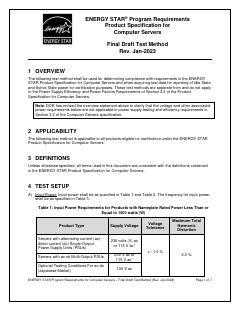
ENERGY STAR Product Specification for Data Center Storage: Test Method (Rev. April 2020)

Record the test-condition envelope (18-28 C inlet, supply voltage) alongside certified storage power values so users know published watts correspond to a cool inlet; apply a temperature-uplift caveat when the design inlet setpoint is higher.

  • Ambient temperature during testing must stay between 18 C and 28 C, relative humidity between 15% and 80%.
Technical guidePDF

U.S. Environmental Protection Agency (ENERGY STAR) 2022

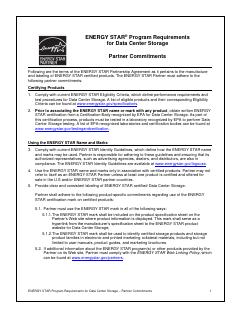
ENERGY STAR Program Requirements for Data Center Storage, Version 2.1 (Partner Commitments and Eligibility Criteria)

Catalogue entries for storage should carry ENERGY STAR status, PSU efficiency curve points (20/50/100%) and power factor, so the rack power model can derive input power and heat from IT load rather than nameplate.

  • PSU power factor minimums: 0.80/0.90/0.95 at 20/50/100% load.

All content and rights belong to the respective authors and publishers. SoSo CAD provides only the citation, its own summary and a link to the source, and is not responsible for the sources' content.

Monthly newsletter · free

Keep your reading list current

Once a month: new library sources, changes to Turkish regulations and upcoming data centre events.