Collection

Recently added

Technical references added to the library in the last 90 days.

Sources
1044
Downloadable PDFs
270
Years
1984–2027

All sources

313–336 / 1044

Research paperPDF

Batteries (MDPI AG) 2025

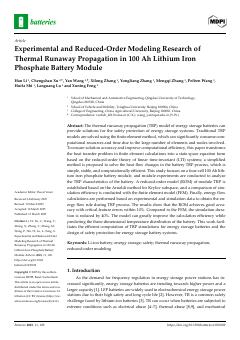
Experimental and Reduced-Order Modeling Research of Thermal Runaway Propagation in 100 Ah Lithium Iron Phosphate Battery Module

In LFP module design, evaluate inter-cell thermal resistance (interface insulation) together with measures that cut heat release to stop propagation; in the model an interface resistance of hR = 100 W·m^-2·K^-1 alone suppressed it.

  • Venting phases (vent opening to runaway) lasted 204 s, 399 s, 156 s and 309 s for cells 1-4.
Research paperPDF

Batteries (MDPI AG) 2026

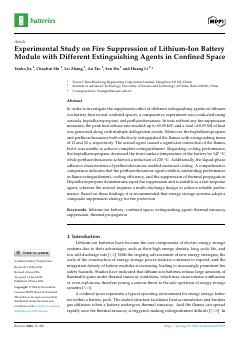
Experimental Study on Fire Suppression of Lithium-Ion Battery Module with Different Extinguishing Agents in Confined Space

For confined battery packs and cabinets, evaluate a fast flame-knockdown agent (such as heptafluoropropane) together with an agent or approach giving long-lasting cooling (such as perfluorohexanone); no single agent stopped heat transfer to neighbouring cells.

  • Without suppression, peak HRR reached 69.09 kW and total heat release was 8.05 MJ, with multiple deflagrations after venting in the confined space.
White paperFree to read

Schneider Electric 2018

FAQs for Using Lithium-ion Batteries with a UPS

Battery catalog: chemistry (VRLA, LFP, NMC, LMO, NCA, LTO, LCO), specific energy, design and cycle life, rated temperature, footprint and weight per kWh, recharge time and compatible UPS models.

  • Li-ion takes 50-80% less floor space and weighs 60-80% less.
Research paperFree to read

Proceedings of the AAAI Conference on Artificial Intelligence (Association for the Advancement of Artificial Intelligence (AAAI)) 2025

Fast 3D Surrogate Modeling for Data Center Thermal Management

Offer a fast-preview thermal mode with a voxel surrogate trained on the tool's own CFD runs: inputs of rack power by segment, CRAH setpoints, fan speeds and vent locations; output a 3D inlet-temperature map in under a second for layout iteration.

  • Surrogate inference took about 100 ms against about 35 minutes for CFD; the abstract states about a 20,000x speed-up.
Research paperPDF

Sustainability (MDPI AG) 2024

Feasibility Analysis of Indirect Evaporative Cooling System Assisted by Liquid Desiccant for Data Centers in Hot-Humid Regions

Where plain IEC falls short in a hot-humid climate (high wet-bulb), consider a liquid-desiccant pre-stage; in the Hong Kong example supplementary mechanical cooling fell from 5092 to 31 h.

  • With a 25 °C supply-air threshold, supplementary mechanical cooling hours fell from 5092 h to 31 h per year.
Technical guideFree to read

STULZ 2015

Free Cooling for Data Centers

Model the cooling-topology choice with five options (direct air, indirect plate, thermal wheel, CRAC with glycol dry cooler, CRAH with chiller economiser), each with a footprint multiplier and an economiser start condition.

  • Older practice: return air at 22-24 C, supply air around 12 C.
Research paperFree to read

IET Generation, Transmission & Distribution (Institution of Engineering and Technology (IET)) 2026

From Liability to Asset: A Three-Mode Grid-Forming Control Framework for Centralized Data Center UPS Systems

For large or AI facilities, record the UPS's fault ride-through behaviour (momentary cessation versus ride-through with minimum grid draw), the inverter current limit and the post-fault ramp rate, alongside the point-of-interconnection short-circuit ratio.

  • Unserved IT energy was 0.00000 MWh with the proposed controller versus 0.00208 MWh for a momentary-cessation benchmark.
Research paperPDF

arXiv preprint (Stanford University / Microsoft Azure Research) 2026

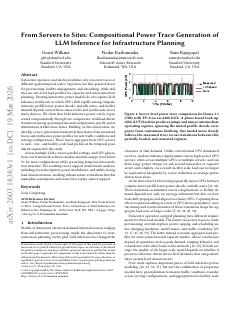
From Servers to Sites: Compositional Power Trace Generation of LLM Inference for Infrastructure Planning

For an AI inference facility, set interconnection capacity from traces generated from the workload, not nameplate TDP or mean power; TDP sizing gave 1.19 MW against 0.75 MW trace-based (about 60% too much).

  • Generated facility traces show a peak-to-average ratio of 1.19, a load factor of 0.84 and a maximum 15-minute ramp of 0.11 MW.

All content and rights belong to the respective authors and publishers. SoSo CAD provides only the citation, its own summary and a link to the source, and is not responsible for the sources' content.

Monthly newsletter · free

Keep your reading list current

Once a month: new library sources, changes to Turkish regulations and upcoming data centre events.