Topic guide

Energy

Discover publications on data centre energy consumption, power demand and efficiency. Investigate measurement methods, operating conditions and improvement approaches through summaries and original references.

Sources
416
Downloadable PDFs
122
Years
2007–2026

All sources

121–144 / 416

Technical guidePDF

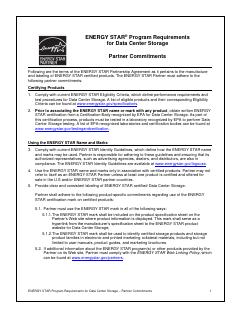
U.S. Environmental Protection Agency (ENERGY STAR) 2022

ENERGY STAR Program Requirements for Data Center Storage, Version 2.1 (Partner Commitments and Eligibility Criteria)

Catalogue entries for storage should carry ENERGY STAR status, PSU efficiency curve points (20/50/100%) and power factor, so the rack power model can derive input power and heat from IT load rather than nameplate.

  • PSU power factor minimums: 0.80/0.90/0.95 at 20/50/100% load.
Technical guidePDF

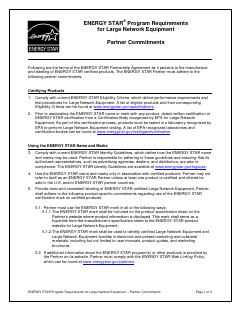
U.S. Environmental Protection Agency (ENERGY STAR) 2016

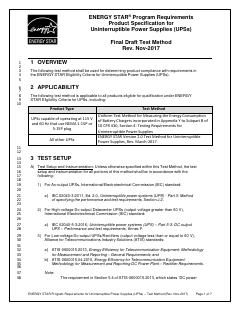
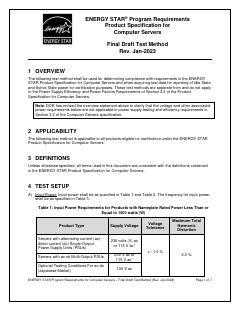
ENERGY STAR Program Requirements for Large Network Equipment, Version 1.1 (incl. Test Method Rev. Jan-2016)

Network catalogue items (ToR and spine switches) should store ENERGY STAR status, PSU efficiency points and measured power at idle, VLU, 30% and maximum load so rack heat loads reflect real utilization.

  • All copper-based physical ports must comply with IEEE 802.3 Clause 78 (Energy Efficient Ethernet).
Technical guideFree to read

European Union Agency for the Operational Management of Large-Scale IT Systems in the Area of Freedom, Security and Justice (eu-LISA) 2026

Energy-efficient data centres: a high-level overview - eu-LISA Research and Technology Monitoring Report 2026

For novice users, show the band labels (very efficient, efficient, average, inefficient) as plain-language feedback next to the computed PUE.

  • PUE bands: <= 1.2 very efficient, <= 1.3 efficient, <= 1.5 average, <= 2.0 inefficient.
White paperPDF

Open Compute Project Foundation 2023

Evaluating the Limits of Door Heat Exchanger Solutions Optimized for Open Rack V3

Build a rear-door HX sizing helper that takes rack kW, airflow (cfm), facility water temperature and liquid-capture fraction and returns approach, leaving air temperature and fan power, with 27 C facility water and 30 C air as default reference points.

  • Assumptions: 30 C ambient (cold-aisle upper limit), sea level, 12-15 C air delta T, W27 facility water.
Research paperPDF

Sustainability (MDPI AG) 2024

Feasibility Analysis of Indirect Evaporative Cooling System Assisted by Liquid Desiccant for Data Centers in Hot-Humid Regions

Where plain IEC falls short in a hot-humid climate (high wet-bulb), consider a liquid-desiccant pre-stage; in the Hong Kong example supplementary mechanical cooling fell from 5092 to 31 h.

  • With a 25 °C supply-air threshold, supplementary mechanical cooling hours fell from 5092 h to 31 h per year.
Technical guideFree to read

STULZ 2015

Free Cooling for Data Centers

Model the cooling-topology choice with five options (direct air, indirect plate, thermal wheel, CRAC with glycol dry cooler, CRAH with chiller economiser), each with a footprint multiplier and an economiser start condition.

  • Older practice: return air at 22-24 C, supply air around 12 C.
Research paperPDF

arXiv preprint (Stanford University / Microsoft Azure Research) 2026

From Servers to Sites: Compositional Power Trace Generation of LLM Inference for Infrastructure Planning

For an AI inference facility, set interconnection capacity from traces generated from the workload, not nameplate TDP or mean power; TDP sizing gave 1.19 MW against 0.75 MW trace-based (about 60% too much).

  • Generated facility traces show a peak-to-average ratio of 1.19, a load factor of 0.84 and a maximum 15-minute ramp of 0.11 MW.

All content and rights belong to the respective authors and publishers. SoSo CAD provides only the citation, its own summary and a link to the source, and is not responsible for the sources' content.

Monthly newsletter · free

Keep your reading list current

Once a month: new library sources, changes to Turkish regulations and upcoming data centre events.