Collection

Power and UPS

Power distribution, UPS, batteries, protection and redundant supply.

Sources
418
Downloadable PDFs
95
Years
1984–2027

All sources

73–96 / 418

Research paperFree to read

arXiv preprint (University College Dublin) 2025

Data Center Model for Transient Stability Analysis of Power Systems

Expose UPS transfer thresholds (voltage %, frequency Hz), return-to-mains delay and staggering across UPS modules as design parameters, and warn when all modules share identical thresholds and delays, since synchronised reconnection can re-trip the grid.

  • Cooling accounts for about 30% of total power of standalone data centers and is modelled as an induction motor.
Technical guideFree to read

Consulting-Specifying Engineer 2013

Data center power strategies

Offer distribution-voltage options (208/120, 415/240, 380 Vdc) with automatic loss and fault-current comparison.

  • 600 Vac reduces copper and fault current but yields no efficiency gain.
Technical guideFree to read

Aksa Power Generation 2020

Data Center Power Systems

Keep both standby and DCC kVA per model in the generator catalog; where data is missing, use DCC ~0.9-0.94 x standby as a flagged estimate.

  • Data-centre generator range up to 3,000 kVA standby.
White paperFree to read

Schneider Electric 2012

Data Center Projects: Advantages of Using a Reference Design

Store reference designs as structured objects with required attribute fields (IT kW range, redundancy N/N+1/2N for power and cooling, density kW/rack, annualized PUE, heat rejection type, estimated cost) plus linked one-lines, layouts and BOM lines (part number, qty, supplier).

  • Graphics: electrical, mechanical and IT one-lines; layouts with dimensions and clearances of racks, PDUs, CRAC/CRAHs, UPSs, generators, switchboards, ATSs; 3D views.
White paperFree to read

Schneider Electric 2012

Data Center Projects: Growth Model

Capture the IT load profile at project setup as four fields (initial kW, minimum final kW, maximum final kW, ramp-up years, default lifetime 10 years), not one design load.

  • kW = BTU/hr x .000293 and kW = tons x 3.52; each IT watt becomes a watt of heat, so the cooling profile equals the load profile.
Technical guideFree to read

Danfoss 2026

Data center solutions powering the digital economy

In the cooling-plant builder keep a component list per subsystem (chiller, CDU, pump skid, heat recovery) with fields for maximum chilled-water temperature, HX approach temperature and VFD THDi.

  • Advanced Active Filter with SiC switches quoted at 98.2% efficiency.
White paperFree to read

Eaton 2013

Data Center Trend: Distributed Power in the White Space

Allow UPS placement in the white space with an airflow-pattern attribute (front-to-back, front-to-top) and count its heat release in the hall cooling load.

  • A 480 V UPS input/output needs no neutral (three wires) and thinner cables than 208 V; a PDU next to the UPS steps down to 208/120 V.
Research paperPDF

Springer Science and Business Media LLC (preprint) 2026

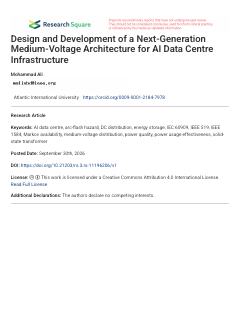
Design and Development of a Next-Generation Medium-Voltage Architecture for AI Data Centre Infrastructure

Make the 0.1-10 Hz oscillation, 1.40 peak-to-mean ratio and coincidence factor explicit inputs in the AI campus load model, and check storage and buffering against grid ramp limits.

  • Conductor mass falls by 97.1%, electrical footprint by 58.1%, annual PUE from 1.42 to 1.11 and 15-year TCO by 32.4%.
Research paperPDF

WSEAS TRANSACTIONS ON POWER SYSTEMS (World Scientific and Engineering Academy and Society (WSEAS)) 2026

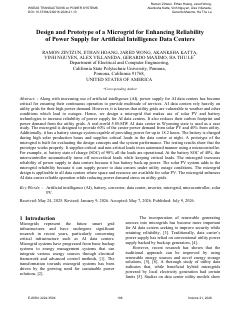
Design and Prototype of a Microgrid for Enhancing Reliability of Power Supply for Artificial Intelligence Data Centers

Follow the energy-balance chain in a PV/BESS sizing helper (daily load split, conversion losses, usable depth of discharge, power rating against night peak); report usable-energy duration rather than nameplate duration and make DoD an explicit input.

  • Covering 60% of demand needs 81,857 kWh/day from PV after 5% DC-AC and 10% battery losses.
Technical guideFree to read

ABB 2008

Directional protection and directional zone selectivity

For main switchboards with two transformers plus bus tie, or generator paralleling boards, flag that conventional time selectivity cannot discriminate fault direction and propose directional or directional-zone selectivity on incomers and bus tie.

  • Without auxiliary power it degrades to plain directional protection with t7FW/t7BW times.

All content and rights belong to the respective authors and publishers. SoSo CAD provides only the citation, its own summary and a link to the source, and is not responsible for the sources' content.

Monthly newsletter · free

Keep your reading list current

Once a month: new library sources, changes to Turkish regulations and upcoming data centre events.