Collection

Scientific papers

Peer-reviewed articles and preprints; most are downloadable under open licences.

Sources
183
Downloadable PDFs
139
Years
2014–2026

All sources

73–96 / 183

Research paperPDF

Journal of Physics: Conference Series (IOP Publishing) 2018

Evaluation of Oxygen Reduction System (ORS) in Large-scale Fire Tests

Compare ORS design concentration with the 15-16% standard-test values in VdS 3527 and EN 16750; since large-scale hard-limit LOCs (11.1% for cartoned commodities, 13.0% for uncartoned plastics) are lower, justify the design safety margin against them.

  • Earlier lab work found LOCs of 10-13% for cardboard, wood, PS and PE, below the 15-16% range from standard tests in VdS 3527 and EN 16750:2017.
Research paperPDF

Buildings (MDPI AG) 2024

Experimental and Numerical Investigation of Airflow Organization in Modular Data Centres Utilizing Floor Grid Air Supply

Choose raised-floor height of 600-800 mm and grille open area of about 40%; a 1000 mm floor gave only a small extra gain, and 20% or 60% open area pushed cabinet intake above 27 °C.

  • With cold-aisle containment entransy loss was 4450 kW·K, and with both cold and hot aisles contained it was 3500 kW·K.
Research paperPDF

Batteries (MDPI AG) 2025

Experimental and Reduced-Order Modeling Research of Thermal Runaway Propagation in 100 Ah Lithium Iron Phosphate Battery Module

In LFP module design, evaluate inter-cell thermal resistance (interface insulation) together with measures that cut heat release to stop propagation; in the model an interface resistance of hR = 100 W·m^-2·K^-1 alone suppressed it.

  • Venting phases (vent opening to runaway) lasted 204 s, 399 s, 156 s and 309 s for cells 1-4.
Research paperPDF

Batteries (MDPI AG) 2026

Experimental Study on Fire Suppression of Lithium-Ion Battery Module with Different Extinguishing Agents in Confined Space

For confined battery packs and cabinets, evaluate a fast flame-knockdown agent (such as heptafluoropropane) together with an agent or approach giving long-lasting cooling (such as perfluorohexanone); no single agent stopped heat transfer to neighbouring cells.

  • Without suppression, peak HRR reached 69.09 kW and total heat release was 8.05 MJ, with multiple deflagrations after venting in the confined space.
Research paperFree to read

Proceedings of the AAAI Conference on Artificial Intelligence (Association for the Advancement of Artificial Intelligence (AAAI)) 2025

Fast 3D Surrogate Modeling for Data Center Thermal Management

Offer a fast-preview thermal mode with a voxel surrogate trained on the tool's own CFD runs: inputs of rack power by segment, CRAH setpoints, fan speeds and vent locations; output a 3D inlet-temperature map in under a second for layout iteration.

  • Surrogate inference took about 100 ms against about 35 minutes for CFD; the abstract states about a 20,000x speed-up.
Research paperPDF

Sustainability (MDPI AG) 2024

Feasibility Analysis of Indirect Evaporative Cooling System Assisted by Liquid Desiccant for Data Centers in Hot-Humid Regions

Where plain IEC falls short in a hot-humid climate (high wet-bulb), consider a liquid-desiccant pre-stage; in the Hong Kong example supplementary mechanical cooling fell from 5092 to 31 h.

  • With a 25 °C supply-air threshold, supplementary mechanical cooling hours fell from 5092 h to 31 h per year.
Research paperFree to read

IET Generation, Transmission & Distribution (Institution of Engineering and Technology (IET)) 2026

From Liability to Asset: A Three-Mode Grid-Forming Control Framework for Centralized Data Center UPS Systems

For large or AI facilities, record the UPS's fault ride-through behaviour (momentary cessation versus ride-through with minimum grid draw), the inverter current limit and the post-fault ramp rate, alongside the point-of-interconnection short-circuit ratio.

  • Unserved IT energy was 0.00000 MWh with the proposed controller versus 0.00208 MWh for a momentary-cessation benchmark.
Research paperPDF

arXiv preprint (Stanford University / Microsoft Azure Research) 2026

From Servers to Sites: Compositional Power Trace Generation of LLM Inference for Infrastructure Planning

For an AI inference facility, set interconnection capacity from traces generated from the workload, not nameplate TDP or mean power; TDP sizing gave 1.19 MW against 0.75 MW trace-based (about 60% too much).

  • Generated facility traces show a peak-to-average ratio of 1.19, a load factor of 0.84 and a maximum 15-minute ramp of 0.11 MW.
Research paperPDF

Energy Advances (Royal Society of Chemistry (RSC)) 2025

Full life cycle assessment of an industrial lead–acid battery based on primary data

For UPS duty with a few cycles a year and minutes of autonomy, compare battery chemistries by environmental impact categories (GWP, ecotoxicity, resource depletion) as well as energy density, because production and EOL dominate.

  • Data centres account for about 37% of the roughly 3.4 billion USD global stationary-battery market, followed by telecom at 25%.
Research paperPDF

IEEE Access (Institute of Electrical and Electronics Engineers (IEEE)) 2026

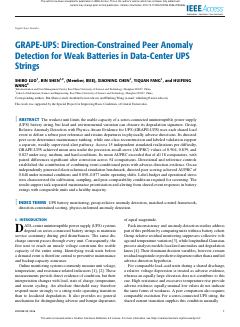
GRAPE-UPS: Direction-Constrained Peer Anomaly Detection for Weak Batteries in Data-Center UPS Strings

Require block-level (per-unit) voltage and resistance monitoring in UPS battery monitoring rather than string totals, citing that one weak unit in a series string limits the whole string's capacity.

  • On an independent electrochemical simulation benchmark, directed peer scoring achieved AUPRC 0.848 under nominal conditions and 0.850-0.877 under operating shifts.
Research paperPDF

Advances in Applied Energy (Elsevier BV) 2026

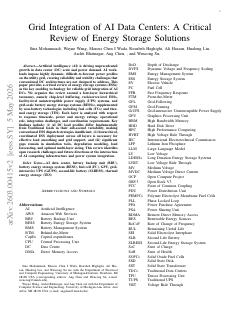
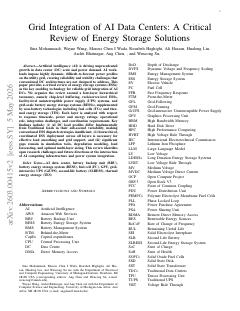
Grid Integration of AI Data Centers: A Critical Review of Energy Storage Solutions

Layer storage by timescale: GPU/server supercapacitors for sub-second swings, rack BBUs for minutes, facility GiUPS and BESS for grid services and longer durations; show each layer's duty and coordination separately in the architecture.

  • BESS cost fell from about $7,500/kWh in 1991 to $133/kWh in 2024, with about $80/kWh projected by 2030.
Research paperFree to read

arXiv preprint (Texas A&M University) 2026

How AI Load Swings Reduce Datacenter Power Conversion Efficiency

In power-chain loss calculators for AI halls, do not evaluate PSU, UPS and transformer efficiency only at average load; accept a load-profile descriptor (duty cycle, high/low power, frequency).

  • Cycle efficiency is computed as (D*PH + (1-D)*PL) / (D*PH/etaH + (1-D)*PL/etaL).
Research paperPDF

Energies (MDPI AG) 2019

Investigation of Heat Management in High Thermal Density Communication Cabinet by a Rear Door Liquid Cooling System

Consider a cabinet-level rear-door heat exchanger as an option that can raise heat dissipation by 56-67% over air cooling; compare oil or water coolant separately on leakage risk and maintenance.

  • For simulated heat-source power of 800-1600 W, average heat-dissipation efficiency of the RDHE was 44.1%.
Research paperFree to read

Proceedings of the 7th ACM International Conference on Systems for Energy-Efficient Buildings, Cities, and Transportation (ACM) 2020

Kalibre: Knowledge-based Neural Surrogate Model Calibration for Data Center Digital Twins

Include a calibration workflow in the hand-over to operations: import aisle sensor data, mark per-server airflow (and bypass/recirculation) as calibration parameters with priors, and report MAE before and after calibration.

  • DOI 10.1145/3408308.3427982; arXiv:2001.10681.
Research paperPDF

International Conference on Learning Representations (ICLR 2024) 2024

LLMCarbon: Modeling the End-to-End Carbon Footprint of Large Language Models

In AI data-centre carbon estimation, compute operational (FLOPs, power, PUE, grid intensity) and embodied (chip area × CPA, memory and storage per GB) carbon together; in a renewable-powered facility embodied carbon rises to 92-95%.

  • Against published Google and Meta figures, error is 8.2% or less for training and -3.05% for embodied carbon.

All content and rights belong to the respective authors and publishers. SoSo CAD provides only the citation, its own summary and a link to the source, and is not responsible for the sources' content.

Monthly newsletter · free

Keep your reading list current

Once a month: new library sources, changes to Turkish regulations and upcoming data centre events.