Collection

Scientific papers

Peer-reviewed articles and preprints; most are downloadable under open licences.

Sources
183
Downloadable PDFs
139
Years
2014–2026

All sources

97–120 / 183

Research paperPDF

arXiv preprint (math.OC), MIT Operations Research Center 2025

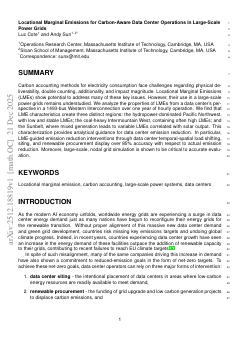
Locational Marginal Emissions for Carbon-Aware Data Center Operations in Large-Scale Power Grids

In data-centre carbon accounting, consider hourly locational marginal emissions (LME) rather than an annual-average grid factor; the LME-based intensity (about 672 kgCO2/MWh) was about 3 times the average factor (202).

  • Emission rates assumed in the simulated grid: coal 800 kgCO2/MWh, gas 450 kgCO2/MWh, wind/solar/nuclear/hydro 0.
Research paperPDF

Scientific Reports (Springer Science and Business Media LLC) 2025

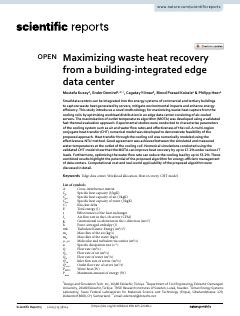
Maximizing waste heat recovery from a building-integrated edge data center

In a building-integrated edge data centre, distribute workload to servers so outlet temperatures are as high as possible (within standard limits); recoverable heat rose by up to 17.1% over random distribution.

  • Compared with randomly distributed workloads, MOTA improves waste-heat recovery by up to 17.1%.
Research paperPDF

arXiv preprint (cs.SE); Skyworkz / Sustainable Digital Infrastructure Alliance (SDIA) 2023

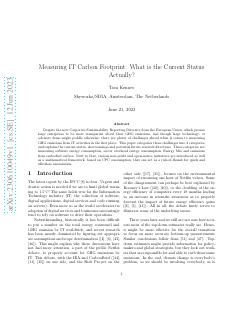
Measuring IT Carbon Footprint: What is the Current Status Actually?

Compute IT carbon as (Es + Eo) × I + M and allocate embodied carbon (M) for shared resources by time and resource share; define scope, idle-time and shared-resource attribution explicitly.

  • Operational carbon = PUE × sum over intervals of grid-mix intensity × energy, constrained by energy-mix data granularity (for example 30-minute updates); average versus marginal emission factors are discussed.
Research paperPDF

IEEE Transactions on Sustainable Computing (Institute of Electrical and Electronics Engineers (IEEE)) 2017

Metrics for Sustainable Data Centers

In data-centre comparisons, do not use PUE as a cross-facility metric; normalise for IT load, weather and location, or state the same conditions.

  • Tier availability figures quoted: Tier I 99.671%, Tier II 99.741%, Tier III 99.982%, Tier IV 99.995%.
Research paperPDF

Frontiers in Environmental Science (Frontiers Media SA) 2026

Net sustainability assessment of AI-driven data centers in the GCC: an MCDA approach framework

In AI data-centre investment assessment in hot, arid regions, weigh carbon, water, social and governance criteria together with explicit weights (0.40/0.25/0.20/0.15); indirect water (desalination energy) was about 0.68 times direct cooling water.

  • In the extended boundary, embodied carbon adds 15-25% to the operational footprint.
Research paperPDF

Applied Sciences (MDPI AG) 2024

Numerical Evaluation of Hot Air Recirculation in Server Rack

Make hot-aisle back pressure (hot-aisle pressure above cold aisle) a design input in contained aisles; server inlet temperature rises once back pressure reaches the fans' free-delivery point.

  • A three-grid GCI study (1.22 to 1.99 million cells) selected a 1,799,871-cell trimmed hexahedral mesh with seven prism layers, near-wall y+ of about 5.
Research paperPDF

Buildings (MDPI AG) 2023

Numerical Investigation of Thermal Performance with Adaptive Terminal Devices for Cold Aisle Containment in Data Centers

For hot-spot removal, before choosing lower supply temperature or higher airflow outright, compare the COP drop (3.2 to 2.6) and the energy difference (20.1% and 4.2%) with a rack-specific air distribution option.

  • A grid study at 260,000 to 1,340,000 cells showed results stabilising at about 560,000 cells.
Research paperPDF

Challenges (MDPI AG) 2015

On Global Electricity Usage of Communication Technology: Trends to 2030

In data-centre electricity-demand projections use traffic-based extrapolation (traffic × annually improving energy intensity) as an upper-bound reference; the worst case is very high and the method was later criticised for overestimating demand.

  • In the worst-case scenario communication technology could use as much as 51% of global electricity in 2030 and contribute up to 23% of global GHG emissions.
Research paperPDF

Energy Strategy Reviews (Elsevier BV) 2024

On the means, costs, and system-level impacts of 24/7 carbon-free energy procurement

In a data-centre renewable procurement strategy, weigh that annual volumetric matching does not deliver hourly clean supply (54% to 83%) and that 85-95% hourly CFE targets cut emissions more at a relatively small premium.

  • Adding long-duration storage (salt-cavern hydrogen, 2.5 EUR/kWh) cuts the 100% CFE premium to 42% above annual matching; also adding clean firm generation cuts it to 15%.
Research paperPDF

Buildings (MDPI AG) 2024

Performance and Applicability Analysis of Indirect Evaporative Cooling Units in Data Centers Across Various Humidity Regions

Assess an IEC unit by climate: natural cooling covered 97% of the year in a dry climate and 43% in a humid one; check the wet-bulb distribution (19 °C threshold) against project climate data.

  • Against packaged air-cooled DX units, IEC energy savings were 57.46% (Urumqi), 48.26% (Beijing) and 39.41% (Shanghai).
Research paperPDF

Frontiers in Energy Research (Frontiers Media SA) 2023

Performance evaluation and modeling of active tile in raised-floor data centers: An empirical study on the single rack

With active tiles, always seal under-rack gaps; if left open, low pressure at the tile surface pulls hot air in under the rack and worsens the lower servers.

  • CRACs were set to 21 °C but delivered 23 °C supply, and thermal load was about 65% of cooling capacity, so one CRAC was off.
Research paperPDF

Journal of Thermal Analysis and Calorimetry (Springer Science and Business Media LLC) 2025

Performance improvement of high-density data center via two-phase liquid immersion cooling

Verify two-phase immersion PUE claims so they include the external heat-rejection loop (exchangers, pumps, pipes) and not just tank-level power; the 1.01 figure excludes it.

  • The study considers high-density data centres with a capacity of up to 1168 kW.
Research paperFree to read

arXiv preprint (Microsoft Azure) 2023

POLCA: Power Oversubscription in LLM Cloud Providers

In the power planner, apply different diversity and oversubscription factors by workload: inference rows can be provisioned below sum-of-nameplate (for example peak about 80% of provisioned), while training rows should assume near-coincident peaks with only about 10% headroom.

  • POLCA allows 30% more servers in the same inference GPU cluster while maintaining SLOs.
Research paperPDF

Geothermal Energy (Springer Science and Business Media LLC) 2026

Potential of aquifer thermal energy storage (ATES) for data centres in Germany

Before linking data-centre waste heat to nearby building heating, check that site subsurface geology suits ATES and that the site is outside water-protection zones; only 13 of 19 sites did.

  • Annual waste heat available for storage was Eth = Qth × F_load × (1 − F_free) × (1 − F_down), with a conservative mean annual load factor of 0.6.
Research paperFree to read

arXiv preprint (Microsoft / OpenAI / NVIDIA) 2025

Power Stabilization for AI Training Datacenters

For AI-training halls, carry a 'synchronous load' flag and capture utility time-domain (MW/s ramp up/down, dynamic range) and frequency-domain (critical band, spectral cap) limits as interconnection inputs.

  • GPU power smoothing with the floor at 90% of TDP gave a total energy overhead of 10.5% in simulation.
Research paperFree to read

arXiv preprint (Emerald AI / EPRI / National Grid / NVIDIA / Oracle; submitted to IEEE) 2026

Power-Flexible AI Data Centers: A New Paradigm for Grid-Responsive Compute

Add a 'flexible load' profile in the grid-connection module: committed reduction depth (%), response time (s), duration (h) and recovery, derived from the workload priority mix.

  • Achieved 100% compliance across 200+ distinct National Grid power events on a 130 kW cluster of NVIDIA Blackwell Ultra GPUs.
Research paperPDF

IEEE Transactions on Industry Applications (Institute of Electrical and Electronics Engineers (IEEE)) 2026

Practical Battery Arc Flash Models

In battery-room arc-flash labelling, calculate the self-extinguishing model alongside the maximum power method rather than using the latter as the only reference, and check cases where excessive PPE categories make maintenance impractical.

  • An arc-in-a-box coefficient of 1.52, based on the value calculated for panelboards, was used for enclosed-space experiments.

All content and rights belong to the respective authors and publishers. SoSo CAD provides only the citation, its own summary and a link to the source, and is not responsible for the sources' content.

Monthly newsletter · free

Keep your reading list current

Once a month: new library sources, changes to Turkish regulations and upcoming data centre events.