Topic guide

Cooling

Explore technical publications on data centre cooling systems, thermal loads and operating conditions. Review air and liquid approaches, energy use and operational requirements within each source’s scope.

Sources
339
Downloadable PDFs
92
Years
2006–2026

All sources

49–72 / 339

RegulationPDF

European Commission 2024

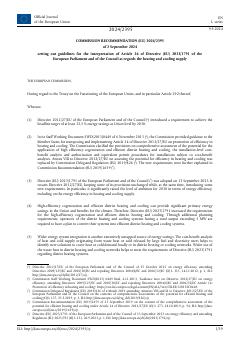
Commission Recommendation (EU) 2024/2395 of 2 September 2024 setting out guidelines for the interpretation of Article 26 of Directive (EU) 2023/1791 as regards heating and cooling supply requirements

When testing the 1 MW waste heat threshold, compute "total rated energy input" from rated capacity (for example utility connection or rated IT plus infrastructure), not modelled annual energy, and take the measurement point at the handover of electricity supply.

  • CBA thresholds: thermal electricity generation 10 MW, industrial installation 8 MW, service facility 7 MW, data centre 1 MW.
RegulationPDF

European Commission 2019

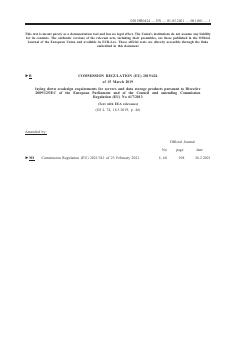
Commission Regulation (EU) 2019/424 of 15 March 2019 laying down ecodesign requirements for servers and data storage products - consolidated text 01.03.2021 (incl. Regulation (EU) 2021/341)

In the IT equipment catalogue store PSU efficiency at 10/20/50/100% load, power factor, active state efficiency (SERT/EN 303470) and declared operating class A1-A4, and validate new models against the 2023 tier.

  • Secure data deletion applies from 1 March 2020; latest firmware and security updates must be made available from 1 March 2021.
Research paperPDF

Energies (MDPI AG) 2019

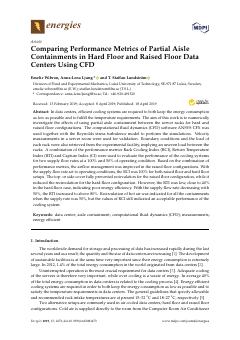
Comparing Performance Metrics of Partial Aisle Containments in Hard Floor and Raised Floor Data Centers Using CFD

In airflow assessment do not rely on RCI alone; RCI of 100% coexisted with RTI of 40-50%, showing oversupply and bypass. Report RTI and per-rack Capture Index together.

  • With supply cut by 50%, RTI rose above 80%, and recirculation appeared in all containment variants while RCI still looked acceptable.
Research paperPDF

Entropy (MDPI AG) 2019

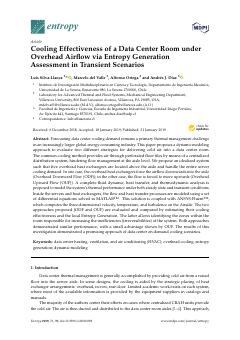
Cooling Effectiveness of a Data Center Room under Overhead Airflow via Entropy Generation Assessment in Transient Scenarios

Use in the design rationale that aisle containment cut air-side entropy generation to negligible levels (0.15% and 0.03%), against 34% for an uncontained legacy room.

  • With containment, air-side entropy generation was only 0.15% (downward flow) and 0.03% (upward flow) of the total, against an earlier estimate of 34% for an uncontained legacy room.
Research paperPDF

Energies (MDPI AG) 2023

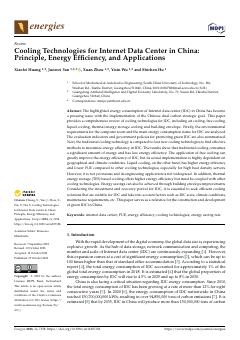
Cooling Technologies for Internet Data Center in China: Principle, Energy Efficiency, and Applications

In China, define project design targets from GB 50174-2017 temperature and humidity limits (18-27 °C, dew point 5.5-15 °C, RH at most 60%) and provincial PUE caps (for example Guangdong 1.25).

  • Cooling accounts for about 35-40% of total IDC energy consumption, the second largest consumer after IT equipment.
Research paperPDF

IEEE Transactions on Cloud Computing (Institute of Electrical and Electronics Engineers (IEEE)) 2026

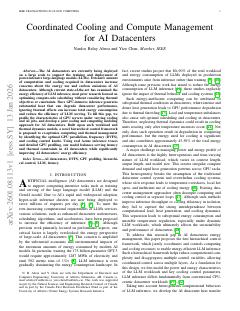
Coordinated Cooling and Compute Management for AI Datacenters

Design AI-hall cooling control together with workload management: when GPU count and tensor parallelism, DVFS and supply air temperature and airflow were optimised jointly, cooling energy fell by 31.2%.

  • Cooling is cited as contributing approximately 45-50% of total energy consumption in AI data centres.
Research paperPDF

IEEE Transactions on Components, Packaging and Manufacturing Technology (Institute of Electrical and Electronics Engineers (IEEE)) 2021

CPU Overclocking: A Performance Assessment of Air, Cold Plates, and Two-Phase Immersion Cooling

For high-heat-flux chips, compare the point at which air cooling throttles (here 3.3-4 GHz) with the clock-rate gain from cold plates or 2P immersion (41-51%) in cooling technology selection.

  • Compared with air cooling, cold plates gave up to 41% and 2P immersion up to 51% higher CPU clock rates.
Technical guideFree to read

Lawrence Berkeley National Laboratory / U.S. Department of Energy 2017

Data Center Air Management Estimator, Version 1.0 (2017)

Offer a 'quick' airflow-management estimate mode with few inputs, consistent with the DOE AM Tool engine already in the library (engineering reference v3).

  • Distributed as an Excel file (AM Estimator Version 1-0), posted 06/27/2017.
Technical guideFree to read

Upsite Technologies blog 2019

Data Center Airflow Management at 100F

When high-temperature (A2/A3 allowable) set points are selected, report hot-hour and mechanical-cooling percentages from site weather.

  • Air-side economization hours above 90 F: Denver 111 (A2) / 226 (A3); Phoenix 694 / 1,817.
StandardFree to read

ASHRAE / IBPSA-USA 2022

Data Center Chiller Plant: Simulation-based Comparative Control Design Case Study (2022 ASHRAE/IBPSA-USA Building Performance Analysis Conference and SimBuild)

Give cooling plant templates a control-sequence attribute (for example Guideline 36 condenser-water reset, economizer modes); it materially changes annual energy.

  • Alternative (Guideline 36-based) controls cut cooling energy 25% annually and about 18% in a typical summer.
Research paperPDF

arXiv (University of Michigan preprint) 2026

Data Center Cooling Choices Shift Water Impacts Across the Grid: An Integrated Water-Energy Model for Sustainable Data Center Development

In cooling selection, calculate direct and indirect water together: an air-cooled chiller cut direct water 97% but raised the indirect share to 96.6% and electricity by 32%.

  • Indirect water intensity varied by about 50% across months, depending on which generators supplied the added load.
Research paperPDF

Buildings (MDPI AG) 2024

Data Center Energy Evaluation Tool Development and Analysis of Power Usage Effectiveness with Different Economizer Types in Various Climate Zones

Choose economiser type by climate zone: consider indirect economisers in 0A/0B and wet zones (PUE 0.03-0.07 lower) and adding evaporative cooling in dry zones (0.02-0.05).

  • More than 95% of a data centre's total cooling load comes from heat generated by IT equipment.
Research paperFree to read

arXiv preprint (University College Dublin) 2025

Data Center Model for Transient Stability Analysis of Power Systems

Expose UPS transfer thresholds (voltage %, frequency Hz), return-to-mains delay and staggering across UPS modules as design parameters, and warn when all modules share identical thresholds and delays, since synchronised reconnection can re-trip the grid.

  • Cooling accounts for about 30% of total power of standalone data centers and is modelled as an induction motor.
White paperFree to read

Schneider Electric 2012

Data Center Projects: Advantages of Using a Reference Design

Store reference designs as structured objects with required attribute fields (IT kW range, redundancy N/N+1/2N for power and cooling, density kW/rack, annualized PUE, heat rejection type, estimated cost) plus linked one-lines, layouts and BOM lines (part number, qty, supplier).

  • Graphics: electrical, mechanical and IT one-lines; layouts with dimensions and clearances of racks, PDUs, CRAC/CRAHs, UPSs, generators, switchboards, ATSs; 3D views.
White paperFree to read

Schneider Electric 2015

Data Center Projects: Establishing a Floor Plan

Run the layout engine on a 600 mm / 2 ft grid with row-pair pitch presets A-D (14/16/16/18 ft), auto-selected from raised-floor, rear-door accessory, containment and density inputs.

  • Rack-location estimate: room area / 28 sq ft (2.6 m2) per rack.
White paperFree to read

Schneider Electric 2012

Data Center Projects: Growth Model

Capture the IT load profile at project setup as four fields (initial kW, minimum final kW, maximum final kW, ramp-up years, default lifetime 10 years), not one design load.

  • kW = BTU/hr x .000293 and kW = tons x 3.52; each IT watt becomes a watt of heat, so the cooling profile equals the load profile.

All content and rights belong to the respective authors and publishers. SoSo CAD provides only the citation, its own summary and a link to the source, and is not responsible for the sources' content.

Monthly newsletter · free

Keep your reading list current

Once a month: new library sources, changes to Turkish regulations and upcoming data centre events.