Collection

Power and UPS

Power distribution, UPS, batteries, protection and redundant supply.

Sources
418
Downloadable PDFs
95
Years
1984–2027

All sources

385–408 / 418

Technical guideCitation

Uptime Institute 2018

Tier Standard: Topology

For Tier III/IV targets, accept only generator ratings flagged 'continuous' or unlimited-hours in the sizing module

  • Minimum 12 hours of on-site fuel at N design load is the baseline; many sites choose 24-72 h
Technical guidePDF

U.S. Army Corps of Engineers (Headquarters, Department of the Army) 2002

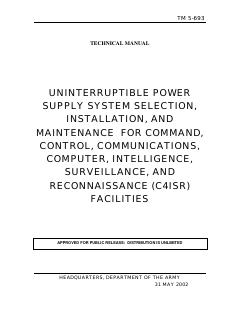
TM 5-693 Uninterruptible Power Supply System Selection, Installation, and Maintenance for Command, Control, Communications, Computer, Intelligence, Surveillance, and Reconnaissance (C4ISR) Facilities (31 May 2002)

Calculate availability from MTBF and MTTR before choosing a UPS configuration; apply the same method to single-unit, N+1 and dual-redundant layouts to compare the gain from redundancy with the cost of the added components.

  • C4ISR facilities require a reliability level of 99.9999 percent (the six-nine rule), which may call for greater redundancy.
Technical guidePDF

Headquarters, Department of the Army (U.S. Army Corps of Engineers) 2007

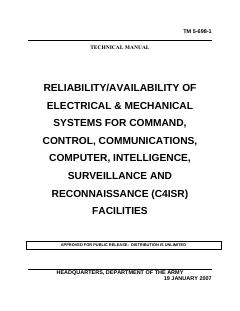
TM 5-698-1 Reliability/Availability of Electrical & Mechanical Systems for Command, Control, Communications, Computer, Intelligence, Surveillance and Reconnaissance (C4ISR) Facilities (19 January 2007)

When writing an availability target into a data centre specification, state the measurement interval as well; the same downtime gives 95.83 or 99.86 percent depending on the interval.

  • With exponentially distributed failures, reliability at an operating time equal to the MTBF is only about 37 percent (e^-1 = 0.368).
Technical guidePDF

U.S. Army Corps of Engineers (Headquarters, Department of the Army) 2006

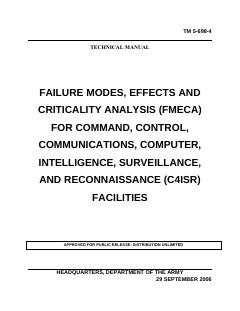
TM 5-698-4 Failure Modes, Effects and Criticality Analyses (FMECA) for Command, Control, Communications, Computer, Intelligence, Surveillance, and Reconnaissance (C4ISR) Facilities (29 September 2006)

At design stage run a functional FMEA of each critical system (power, generators, cooling); do not start without schematics, bill of materials, block diagram and the mission requirement.

  • The Risk Priority Number is Severity (1-10) x Occurrence (1-10), optionally multiplied by Detection: RPN = S x O x D.
Technical guidePDF

Headquarters, Department of the Army (U.S. Army Corps of Engineers PREP) 2006

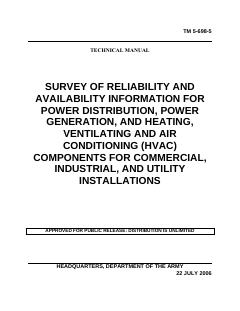
TM 5-698-5 Survey of Reliability and Availability Information for Power Distribution, Power Generation, and Heating, Ventilating and Air Conditioning (HVAC) Components for Commercial, Industrial, and Utility Installations (22 July 2006)

When modelling the power and cooling chain use these values as starting failure rates and MTBF/MTTR inputs and convert them into availability with the method of TM 5-698-1.

  • Diesel engine generators overall: 0.528 failures/yr, MTBF about 16,590 h, MTTR 24.22 h, operational availability 0.99399.
Technical guidePDF

U.S. DoD (UFC) 2023

UFC 3-540-01 Engine-Driven Generator Systems for Prime and Standby Power Applications (1 August 2014, Change 3, 26 January 2023)

Include transient and steady-state loads, transformer inrush, motor starting and UPS load in the generator sizing study, and calculate UPS charging load using the minimum charging current allowed while on generator.

  • Harmonic analysis is required when switching power supplies make up 25% or more of the system load.
Technical guidePDF

U.S. DoD (UFC) 2019

UFC 3-550-01 Exterior Electrical Power Distribution (1 September 2016, Change 3, 01 November 2019)

Settle the loop or alternate-feed arrangement and the maintenance isolation points for the MV run from utility entry to the building early; the text treats shortening maintenance outages as a direct design driver.

  • Elbow-type arresters go at the ends of all radials and at normally open loop points, for all voltages above 5 kV.
Technical guidePDF

U.S. DoD (UFC) 2021

UFC 3-600-01, Fire Protection Engineering for Facilities (8 August 2016, Change 6, 6 May 2021)

Build the data hall protection concept in this order: very early warning smoke detection, wet-pipe sprinklers throughout, clean agent only as an addition, and state in the specification that clean agent cannot replace the sprinklers.

  • Stand-alone telecommunication facilities over 2,500 ft2 (232 m2) need clean agent or sprinklers; over 7,500 ft2 (696 m2) sprinklers are required and clean agent may only be added.

All content and rights belong to the respective authors and publishers. SoSo CAD provides only the citation, its own summary and a link to the source, and is not responsible for the sources' content.

Monthly newsletter · free

Keep your reading list current

Once a month: new library sources, changes to Turkish regulations and upcoming data centre events.