Calculate cooling plant efficiency from the lifecycle-average COP reflecting progressive IT load ramp rather than the design-point COP (in Beijing 2.9 lower than design).
Free-cooling hours at PLR 1 ranged from 5921 h in Ulanqab to only 158 h in Hong Kong.
Assess heat recovery from chilled-water return with a water-source heat pump and hot-water storage in annual-hour simulation; match the winter and summer outlet temperature difference (45 and 30 °C) to the user's need.
Free natural-resource cooling covers about 28% of the cooling demand.
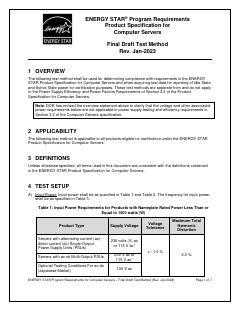
Record the test-condition envelope (18-28 C inlet, supply voltage) alongside certified storage power values so users know published watts correspond to a cool inlet; apply a temperature-uplift caveat when the design inlet setpoint is higher.
Ambient temperature during testing must stay between 18 C and 28 C, relative humidity between 15% and 80%.
Catalogue entries for storage should carry ENERGY STAR status, PSU efficiency curve points (20/50/100%) and power factor, so the rack power model can derive input power and heat from IT load rather than nameplate.
PSU power factor minimums: 0.80/0.90/0.95 at 20/50/100% load.
Network catalogue items (ToR and spine switches) should store ENERGY STAR status, PSU efficiency points and measured power at idle, VLU, 30% and maximum load so rack heat loads reflect real utilization.
All copper-based physical ports must comply with IEEE 802.3 Clause 78 (Energy Efficient Ethernet).
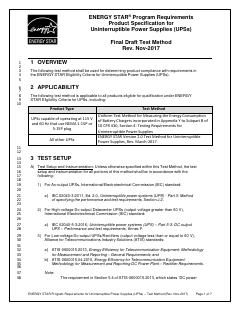
Add a ride-through check to the electrical module: compare the selected UPS input tolerance (IEC 62040-3 class) and IT tolerance (ITI/CBEMA) against the applicable grid-code LVRT envelope for the site's region, and flag the gap.
IEC 62040-3 (UPS) and ITI/CBEMA (IT loads) are the least strict compared with proposed TSO grid codes, with a substantial performance gap.
In gigawatt-scale data-centre interconnection studies, add the load-loss scenario from IT load transferring to UPS in a voltage dip (for example 5 × 200 MW with a 1:1 split giving 500 MW) to the grid frequency and voltage analysis.
Data-centre plant sizes are cited as ranging between 500 MW and 2 GW.
In the layout tool, auto-place temperature/humidity sensors at least every fourth cabinet or every 3-9 m of aisle, at inlet heights including about 1.5 m, and flag aisles with none.
About 80 F is near the point where server fans speed up.
In the metering plan generator, confirm meters exist to produce the chosen maturity tier's metric set: total facility kWh, IT kWh for PUE, renewable kWh, site water m3 for WUE, reused energy for ERF.
Over 40 countries require GHG reporting; a provider's Scope 1 and 2 emissions are a significant source of tenants' Scope 3.
In the electrical/grid module, let users declare a flexible-load capability (curtailable MW, duration, ride-through via BESS) for interconnection studies.
Workstream 5: distribution-connected data centres (DxDCs).
In pipe and manifold sizing rules, check coolant velocity against a configurable copper limit, warning above about 1.5 m/s for warm-water loops and at a lower threshold above 60 C.
Visual differences appeared after about 3 days and surface changes after 146-318 hours.
Create an "EU GPP 2020 (core/comprehensive)" compliance profile: check refrigerant GWP <= 10 in the cooling catalogue, REF = 1 for third-party facilities, ICT class A2/A3 and the W class of liquid loops.
AC11 points: x for GWP 0-10, 0.6x for 11-150, 0.2x for 151-750.
Build a rear-door HX sizing helper that takes rack kW, airflow (cfm), facility water temperature and liquid-capture fraction and returns approach, leaving air temperature and fan power, with 27 C facility water and 30 C air as default reference points.
Assumptions: 30 C ambient (cold-aisle upper limit), sea level, 12-15 C air delta T, W27 facility water.
In a two-phase immersion tank, set server spacing by power: at least 15 mm at 1000 W and 20 mm at 1500 W for the 85 °C surface limit, and wider for 2000 W and above.
All content and rights belong to the respective authors and publishers. SoSo CAD provides only the citation, its own summary and a link to the source, and is not responsible for the sources' content.