Topic guide

Operations

Explore publications on data centre operations, maintenance, monitoring and routine technical processes. Review operational guidance in the context of your facility’s equipment, responsibilities and procedures.

Sources
232
Downloadable PDFs
47
Years
2002–2027

All sources

25–48 / 232

RegulationFree to read

T.C. Cumhurbaşkanlığı Siber Güvenlik Başkanlığı 2026

Bilgi ve İletişim Güvenliği Rehberi - 3.6.2 Sistem Odası/Veri Merkezine Yönelik Güvenlik Tedbirleri (Information and Communication Security Guide - measures for system rooms/data centres)

Provide a Turkey public-sector compliance checklist mapping the measures to design objects: dedicated IT UPS, N+1 air conditioning with auto changeover, redundant feeds, generator fuel redundancy, room adjacency checks against wet areas.

  • Water, power, humidity, temperature and smoke must be monitored with thresholds and alarms; monitoring must not be exposed externally (3.6.2.5).
Research paperPDF

arXiv preprint (cs.SE), Google 2024

Carbon accounting in the Cloud: a methodology for allocating emissions across data center users

In allocating carbon to data-centre users, give idle power to whoever holds the resource allocation and share dynamic power by actual usage; because an idle server draws about 45% of peak power, the idle share is large.

  • Resources with equivalent busy power used to weight idle-power allocation: 1 Intel Skylake N1 CPU core = 20 GiB RAM = 1 TiB SSD = 6 TiB HDD.
Research paperPDF

IEEE Transactions on Power Systems (Institute of Electrical and Electronics Engineers (IEEE)) 2021

Carbon-Aware Computing for Datacenters

Consider shifting temporally flexible workloads (completable within 24 hours) to hours of lower carbon intensity and lower power peak as an option in data-centre grid-connection negotiation and power capacity planning.

  • A piecewise-linear model of power versus CPU usage achieves daily MAPE below 5% for more than 95% of power domains.
Research paperPDF

Journal of Engineering Research and Sciences (Journal of Engineering Research and Sciences) 2026

CFD Analysis of Data Center Hall Cooling Performance under Normal and Failure Modes with Control Strategies and Airflow Leakages

Do thermal verification of failure mode (two ACUs offline) with realistic air leakage (cabinet gaps, HAC panel joints); a leak-free model can comply while the leaky model exceeds 32 °C.

  • The grid study selected 7,288,454 cells with the standard k-epsilon model and wall functions.
RegulationPDF

European Commission 2024

Commission Recommendation (EU) 2024/2002 of 24 July 2024 setting out guidelines for the interpretation of Article 11 of Directive (EU) 2023/1791 as regards energy management systems and energy audits

Show in the operations module whether site annual energy crosses 10 TJ (audit) or 85 TJ (certified ISO 50001 energy management system); in unit terms 10 TJ is about 2.78 GWh and 85 TJ about 23.6 GWh.

  • A cited study gives audit payback of 3.1 years or less, and under 1.16 years for enterprises above 10 TJ.
Research paperPDF

IEEE Transactions on Cloud Computing (Institute of Electrical and Electronics Engineers (IEEE)) 2026

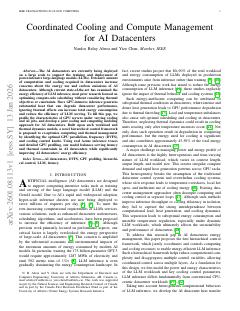
Coordinated Cooling and Compute Management for AI Datacenters

Design AI-hall cooling control together with workload management: when GPU count and tensor parallelism, DVFS and supply air temperature and airflow were optimised jointly, cooling energy fell by 31.2%.

  • Cooling is cited as contributing approximately 45-50% of total energy consumption in AI data centres.
StandardFree to read

ASHRAE / IBPSA-USA 2022

Data Center Chiller Plant: Simulation-based Comparative Control Design Case Study (2022 ASHRAE/IBPSA-USA Building Performance Analysis Conference and SimBuild)

Give cooling plant templates a control-sequence attribute (for example Guideline 36 condenser-water reset, economizer modes); it materially changes annual energy.

  • Alternative (Guideline 36-based) controls cut cooling energy 25% annually and about 18% in a typical summer.
White paperFree to read

Schneider Electric 2012

Data Center Projects: Advantages of Using a Reference Design

Store reference designs as structured objects with required attribute fields (IT kW range, redundancy N/N+1/2N for power and cooling, density kW/rack, annualized PUE, heat rejection type, estimated cost) plus linked one-lines, layouts and BOM lines (part number, qty, supplier).

  • Graphics: electrical, mechanical and IT one-lines; layouts with dimensions and clearances of racks, PDUs, CRAC/CRAHs, UPSs, generators, switchboards, ATSs; 3D views.
White paperFree to read

Schneider Electric 2012

Data Center Projects: Growth Model

Capture the IT load profile at project setup as four fields (initial kW, minimum final kW, maximum final kW, ramp-up years, default lifetime 10 years), not one design load.

  • kW = BTU/hr x .000293 and kW = tons x 3.52; each IT watt becomes a watt of heat, so the cooling profile equals the load profile.
White paperFree to read

Schneider Electric 2013

Data Center Projects: System Planning

Build an intake wizard that makes the six parameters (criticality/Tier, IT kW, growth ramp with uncertainty, target PUE, average and peak kW/rack, capex budget) required before layout tools unlock, with live trade-offs between them.

  • Preferences are adjustable (overhead power cabling, wide racks); constraints are hard (slab height, floor load, columns, codes, TIA 942, work rules, elevator weight capacity).
Technical guideFree to read

U.S. Environmental Protection Agency (ENERGY STAR) 2026

Data Centers for Utilities (ENERGY STAR)

In the cost model, attach utility incentive data (rebates) to measures such as efficient UPS, containment and economizers.

  • A cited 2016 study put downtime cost at $9,000 per minute, driving risk-averse over-redundancy.

All content and rights belong to the respective authors and publishers. SoSo CAD provides only the citation, its own summary and a link to the source, and is not responsible for the sources' content.

Monthly newsletter · free

Keep your reading list current

Once a month: new library sources, changes to Turkish regulations and upcoming data centre events.