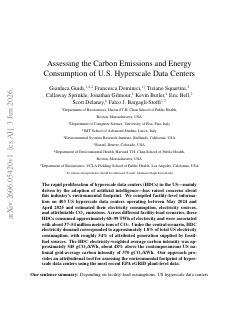
In fleet or facility energy estimation, use capacity × 8,760 × facility-load coefficient (0.48-0.70, central 0.58) and report the range (67.7-98.6 TWh) explicitly.
State-level intensities (central scenario): Virginia 535, Oregon 440, Iowa 645, Nebraska 740, Wyoming 1035 gCO2/kWh; Virginia had 142 HDCs, 21.0 TWh, 11.5 Mt.
Align the PUE target of new designs with the proposed MPS: design PUE below 1.3 and operational PUE below 1.4 in the first three years; for existing sites plan the path to below 1.5 by 2030.
MPS feasibility was tested across 27 data centre archetypes with selected best available techniques (BAT).
In layout validation, raise an error when adjacent rows of front-to-back equipment face the same direction, and a warning for perforated tiles or supply diffusers in a hot aisle.
About 25% of data centres face all racks the same way; over 30% of hot/cold-aisle rooms get supply and return wrong.
In the capacity planner keep design, installed and expected-load curves separate per phase and show utilisation over a 10-year horizon; default start-up load to 20-30% of design and final load to 60-90%.
Total excess lifecycle cost from oversizing averages about 30%.
Use the summary table as validation rules for immersion-fluid catalogue entries: flash point, pour point, viscosity, density and dielectric properties.
Pour point below -30 C; critical temperature above 155 C.
When presenting UPS battery autonomy as a way to improve generator reliability, compute the reserve threshold against the mission duration and report that autonomy of minutes adds little to long-outage generator reliability.
For a 72 h mission with Fehr parameters: 0.95617 with one generator, 0.95847 with an ideal 4 h battery reserve, 0.99808 with two independent generators.
In the energy module, when on-site CHP/trigeneration is modelled, report PUE together with source-aware metrics (primary energy, CO2 and optionally exergy-based figures).
In a large-load interconnection application, verify the relevant entity's large-load threshold (10-75 MW) and ramp limit (Southern ≤20 MW/min) early; definitions differ widely between entities.
Southern Company is the only entity in this review with a numeric ramp cap: ≤20 MW/min under normal operation.
In siting and community-acceptance files, present PUE, WUE and CUE together with regional water stress, grid headroom and verification maturity (L0-L4); back project commitments with contractual limits and independent metering (L2-L3).
Compliance gate: any unresolved major regulatory violation caps the composite score at a ceiling of 40 (suggested, subject to calibration).
Provide a Turkey public-sector compliance checklist mapping the measures to design objects: dedicated IT UPS, N+1 air conditioning with auto changeover, redundant feeds, generator fuel redundancy, room adjacency checks against wet areas.
Water, power, humidity, temperature and smoke must be monitored with thresholds and alarms; monitoring must not be exposed externally (3.6.2.5).
All content and rights belong to the respective authors and publishers. SoSo CAD provides only the citation, its own summary and a link to the source, and is not responsible for the sources' content.