Topic guide

Energy

Discover publications on data centre energy consumption, power demand and efficiency. Investigate measurement methods, operating conditions and improvement approaches through summaries and original references.

Sources
416
Downloadable PDFs
122
Years
2007–2026

All sources

241–264 / 416

Research paperPDF

IEEE Open Journal of Power Electronics (Institute of Electrical and Electronics Engineers (IEEE)) 2026

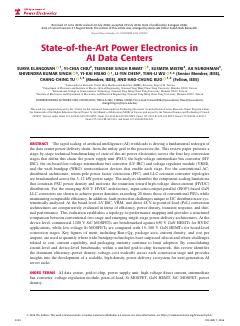
State-of-the-Art Power Electronics in AI Data Centers

In rack power templates, model PSU count per shelf and the 33 kW shelf limit for AC distribution, and check busbar, PDU and cooling impact together for racks that exceed 100 kW with several shelves.

  • AI rack density is 30-100+ kW against 7-10 kW for traditional racks; an 8-GPU DGX H100 draws around 10,200 W.
Research paperFree to read

Revista de Informática Teórica e Aplicada (Universidade Federal do Rio Grande do Sul) 2019

Stochastic Models for Optimizing Availability, Cost and Sustainability of Data Center Power Architectures through Genetic Algorithm

Recognise that topology choice is only part of availability; equipment selection within a fixed topology can trade availability, losses and cost.

  • Tier I: cost 122,322.20 to 116,004.52 USD (5.16%), exergy 203.39 to 140.13 J (31.10%), availability 3.3643 to 3.4005 nines.
Research paperPDF

Sustainability (MDPI AG) 2021

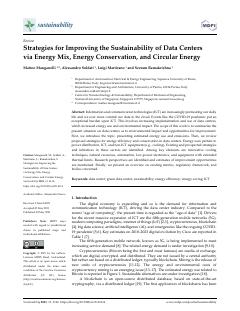
Strategies for Improving the Sustainability of Data Centers via Energy Mix, Energy Conservation, and Circular Energy

Calculate UPS load ratio (80% for 800 kW in a modular arrangement, 53% in parallel-redundant) and losses at design stage; consider specifying UPS efficiency at 30% load and compare a SiC-based power stage (above 98%).

  • CUE is defined as total CO2 emissions over ICT energy, or equivalently the CO2 emission factor × PUE.
Research paperPDF

Sustainability (MDPI AG) 2026

Sustainable Grid Integration of AI Data Centers: Carbon-Aware Co-Optimization of Training Workloads and Battery Storage Under Renewable Uncertainty

Do not size behind-the-meter battery storage on an emission-reduction case; round-trip losses mean storage alone adds nothing and can raise emissions. Justify it with a concrete duty such as masking checkpoint dips.

  • The modelled AI fleet drew about 627 MWh/day (about 152 t/day CO2); flexibility abated 39 t/day, about 26% of the fleet's own emissions.
Technical guidePDF

European Commission, DG CNECT (EY, Borderstep Institute, AIT, RP legalitax) 2025

Synergies between Data Centres and Energy Systems - Final Report (European Commission, DG CNECT)

When choosing cooling architecture assess waste heat temperature early: liquid cooling gives higher temperatures, even air cooling can give about 30-35 C as a heat-pump source; position the heat pump for the receiving network temperature (60-80 C or 4th/5th generation).

  • In the stakeholder survey, over 60% rated heat reuse technically viable today but only about 20% economically viable.
Research paperPDF

Mitigation and Adaptation Strategies for Global Change (Springer Science and Business Media LLC) 2022

Techno-economic analysis of a PV/T waste heat–driven compound ejector-heat pump for simultaneous data centre cooling and district heating using low global warming potential refrigerants

When combining data-centre cooling and heat recovery for district heating in one heat-pump system, select the refrigerant among low-GWP alternatives with COP, PUE, ERF and payback together.

  • R290 gave the highest ERF of the refrigerants examined.
Research paperFree to read

Swiss Federal Office of Energy SFOE (Energy Research and Cleantech); preprint on arXiv 2025

Temperature Optimisation in Data Centres (TODC) - Final report

Add an IT-side penalty of about 0.3-0.6% of IT power per C of inlet rise above about 23 C (a configurable default) to the setpoint optimiser and energy calculator, and model fan power with the cube of speed.

  • Reported hyperscale inlet temperatures: Google 26.6 C, Microsoft 27 C, Meta 29.4 C.
Research paperPDF

Energies (MDPI AG) 2025

Thermo-Economic Potential of Carnot Batteries for the Waste Heat Recovery of Liquid-Cooled Data Centers with Different Combinations of Heat Pumps and Organic Rankine Cycles

When evaluating turning liquid-cooled data-centre waste heat into electricity, weigh RTE (76-83%) against specific cost (767-1125 USD/kWh); higher RTE can come with a cost increase.

  • System cost is about 767-796 USD/kWh depending on the cycle combination.
Research paperPDF

arXiv preprint (University of Alberta) 2026

To Defer or To Shift? The Role of AI Data Center Flexibility on Grid Interconnection

In large-load interconnection negotiation, present AI load flexibility (a deferral window of up to about 3 hours) as a lever for interconnection capacity and timing; returns diminish beyond 3 hours.

  • In the IEEE 14-bus study, data centres on buses connected to congested lines benefit most from geographic load shifting.

All content and rights belong to the respective authors and publishers. SoSo CAD provides only the citation, its own summary and a link to the source, and is not responsible for the sources' content.

Monthly newsletter · free

Keep your reading list current

Once a month: new library sources, changes to Turkish regulations and upcoming data centre events.